

One of my favorite parts about recruiting isn’t just filling jobs. It’s talking to people who solve problems.
This week I had a conversation with Catia, a technical recruiter who’s spent the last decade sourcing engineering talent. We started talking about GitHub sourcing, and within a few minutes she casually mentioned she’d built her own sourcing workflow in n8n.
Why did she spend time upskilling?
Because she got tired of doing the same repetitive work every day.
And that my friends…that immediately had my attention.
The Problem Wasn’t Finding Candidates
It was all the manual effort associated to sourcing and finding them consistently.
Anyone who’s sourced technical talent knows the drill.
You tweak search strings. Open profile after profile. Compare candidates against the job description. Jot your notes. Copy links into a spreadsheet or ATS. Repeat and route for outreach.
There’s nothing particularly difficult about it. It’s just manual, repetitive work that eats up hours.
If you know, you know.
So instead of accepting that as part of the job, she decided to build a better process.
She Didn’t Start by Learning How to Code
This was probably my biggest takeaway.
She didn’t spend months like I did trying to become a junior developer.
She used Claude as a learning partner to understand how n8n works, how workflows are structured, how different nodes connect together, and how to troubleshoot when things broke. Once she understood the fundamentals, she leaned on n8n’s AI Assistant to help accelerate the build.
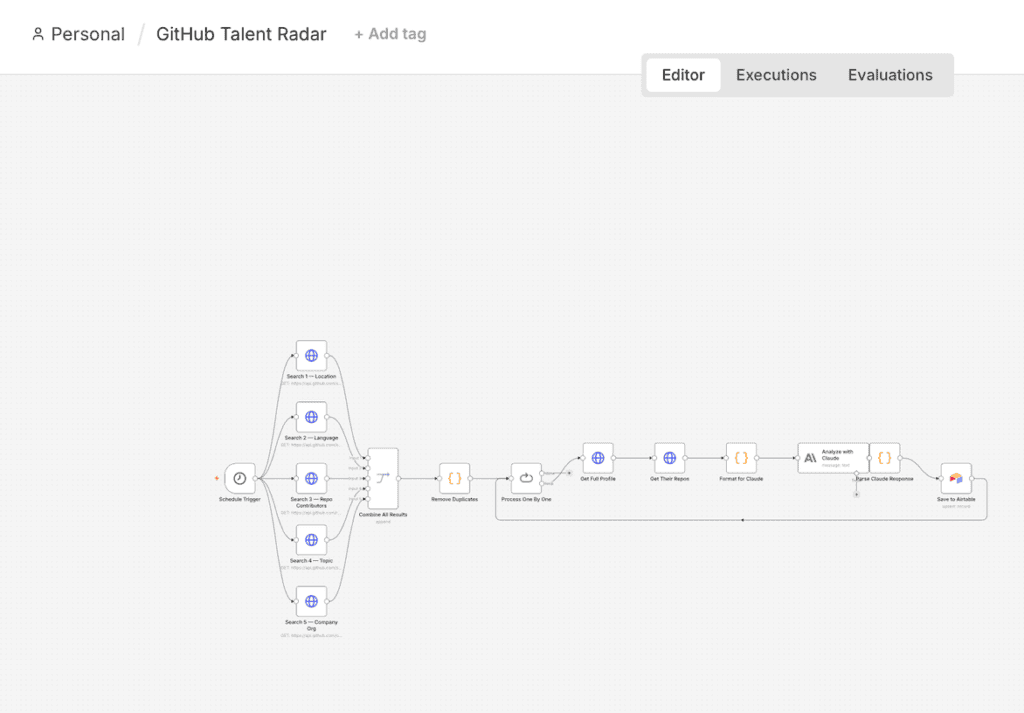
The result was an automated sourcing workflow.
It runs against GitHub using search criteria she defines, whether that’s Engineers for a specific GitHub repository, Engineers who have built their own library others are forking, and other parameters. It evaluates profiles, ranks candidates based on fit, writes a summary explaining why someone matches the role, generates a personalized outreach hook, and pushes everything into Airtable.
One feature I especially liked was the duplicate detection.
Instead of creating another record for someone already in her pipeline, the workflow flags that candidate as a strong match for the new role. That’s the kind of operational thinking I love seeing. It helps recruiters spot multiple opportunities for someone they might have otherwise missed.
This absolutely beats showing up with a blank slate.
Her Best Advice Had Nothing to Do with AI
I asked what she’d tell another recruiter who isn’t technical but wants to build something similar.
Her answer was simple: She said not to spend twenty hours watching YouTube videos expecting to magically know how to build once you open n8n. Learning concepts and implementing them are two different skills.
Instead, learn just enough to understand the basics, then jump in.
Build something. Break something. Get stuck. Figure it out. Repeat.
I told her, “Getting stuck is not exactly fun.”
She laughed and said, “It’s not about ‘fun’, it’s about learning. How will you know what options you have, the tradeoffs within each node, workflow or tool without earning more knowledge? Be patient, and it will pay off.”
And honestly when you put it like that…I couldn’t agree more.
Don’t Limit Yourself to One Tool
Another piece of advice Catia shared was she encourages people to research different tools instead of defaulting to the first one they learn.
Whether it’s Airtable versus Notion, Claude versus another model, or one automation platform versus another, every tool has tradeoffs.
If you’ve only used one option, it’s hard to know whether it’s actually the best fit for your use case.
I’ve noticed the same thing talking with recruiters.
Some only know one AI model. Some only use one sourcing platform. Some only know one way to solve a problem.
The more systems you explore, the better you become at choosing the right one for the job.
My Biggest Takeaway
I love n8n but the conversation wasn’t really about that. Or GitHub.
It was about ownership.
Instead of accepting a repetitive process, Catia invested the time to understand the tools available to her and built something that makes her job better.
I think that’s a trend we’re going to see more of over the next few years with top operators.
Recruiters don’t need to become software engineers. But the recruiters who learn how to think in systems, experiment with AI, and automate repetitive work are going to operate very differently than the ones who don’t.
And honestly? Those are some of my favorite conversations to have.
A Nod to Catia
A nod to Catia from PromptMates for sharing her build, process and advice for folks trying to enter this arena.
Highly encourage you to check out her GitHub: Github-Talent-Radar