
Learning unfamiliar technical skill sets can be challenging as a recruiter. I can read through a job description, research the technologies, and take notes during an intake meeting, but sometimes it takes talking to people to better understand what my own team is looking for.
Ex: I’m supporting this senior software engineering role (btw the title online for the role was: Sr AI Engineer. I’m trying not to call it an “AI” engineer as I talk because its become too much of a buzz word and vague description) focused on modernizing manufacturing and supply chain operations through application development, systems integration and GenAI solutions.
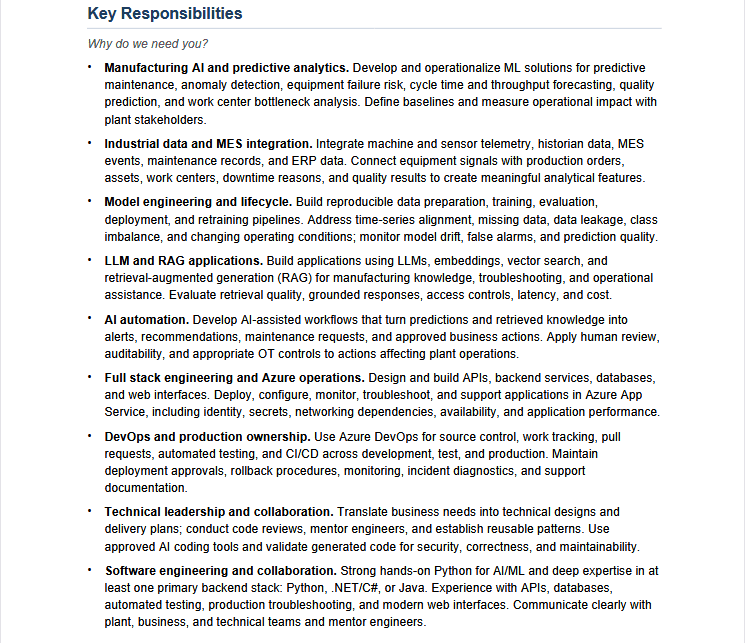
The original job description was extensive. It covered everything from predictive analytics, machine learning, industrial IoT, and MES integration to LLMs, RAG, Azure infrastructure, DevOps, and full-stack engineering.
I’m new to the company and had a limited window to speak with management, so I took the information I did gather and brought the job description to a senior engineer, Will. I walked him through the opportunity, explained what I understood about the role, and then asked what questions he had.
1. Taking the job description to an engineer
And of course, he had questions. Some were about the actual project scope and team and others about the technologies involved, how the systems interacted, and which skills were essential versus required and what could be transferable.
A Few Q’s Asked:
– They talk about having python, java and .net. What is the environment and what programming languages are they actually working with? What about if someone has strong cloud experience but on AWS?
– How big is the internal team? Are there 3rd party vendors involved for an initiative like this that this person will need to manage?
– How much of the job is putting senors into machine vs getting the data feed and I am responsible for seeing what machine isn’t working correctly etc?
– How far along in the transformation process are they? Do you have all senors set up, do you have fail safes, do they have systems that check the sensors, do they have data streams set up?
– Is the focus on GenAI development (LLMs, RAG, embeddings, etc.), or do you also need someone with experience building predictive analytics solutions using manufacturing data?
I took those questions and got some clarification.
2. Revisiting the role with the hiring team
I went back to the team to get more info and was able to better articulate what they were looking for.
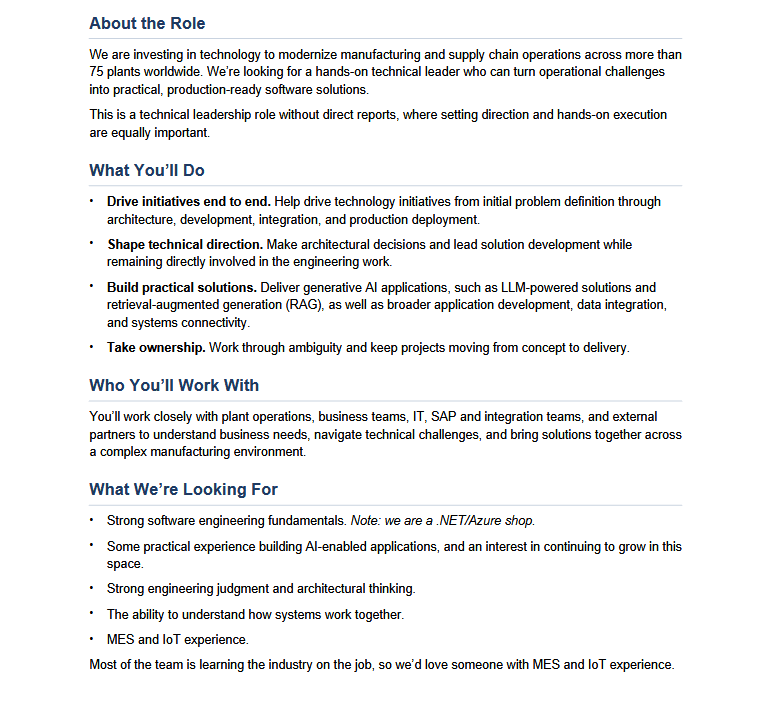
The original description provided a lengthy list of technical requirements. The additional conversations helped bring the purpose of the role into focus: a hands-on technical leader who could take initiatives from initial problem definition through architecture, development, integration, and production deployment.
The manager was in meetings all week but I spoke with a lead on the team and incorporated that context into the role overview to better communicate the opportunity and the type of engineer the team wanted to attract. Before on the Left. After on the Right. The role was open online for 3-4 weeks and received over 700 applications.
3. Building a candidate screening approach
I asked Will to put together technical questions he would recommend asking candidates during initial conversations.
The goal was to move beyond matching keywords on a resume and develop a better understanding of someone’s actual experience, technical depth, and ability to apply their knowledge.
Vetting Questions:
– Tell me about your experience working with MES or industrial IoT environments. Have you worked directly with machine data, sensor telemetry, production events, or equipment information? How was that data collected and integrated into other systems? If you haven’t worked directly in manufacturing, have you worked with C++ or embedded systems, firmware, or other technologies involving hardware-to-software communication? How familiar are you with the process of connecting physical devices to applications and transmitting data?
– Tell me about an application or platform you’ve personally designed and developed that required integrating multiple systems. What was your role in the architecture, what technologies did you use, and how did you handle the APIs, data flow, and backend services?
– Walk me through an AI or machine learning solution you’ve personally taken beyond a proof of concept into a production environment. What did you build, how was it deployed, and how did you monitor its performance after implementation?
The point?
I’m still working on this specific role but I thought it was worth highlighting as a recruiter the importance of painting the full picture so you can bring in the proper talent. The more information I can gather up front the better match I can make.