

When I first started in staffing, I remember watching my Account Managers and Delivery Managers spend entire days “in the pit” with new recruiters. A req would come in, and someone senior would sit down next to a junior recruiter and walk them through everything: reading the job description, figuring out what it actually meant, building out search strings, digging into an unfamiliar tech stack, sourcing candidates together, and then pairing up on calls so the recruiter could hear how to talk about the role without sounding like they were reading off a script.
It worked. But it was slow. And when I moved into managing and training recruiters myself, I found myself doing the exact same thing because there wasn’t really another way to do it. Technical recruiting has always had this gap: the people best equipped to find and close candidates are often the least equipped to understand what the candidate actually does all day. Closing that gap has traditionally meant one thing: a senior person’s time (someone who is technical and knows their space), 1-2 recruiters at a time.
So when I stumbled on Ashish, a TA who’d actually built something to close that gap, I had to pull him aside for a tour. He’d moved from engineering into recruiting himself, got tired of watching the same gap play out over and over, and finally decided to just build the fix.
What is RecruiterOS
At a high level, RecruiterOS is a web app that sits on top of the tools recruiters already use, not a replacement for your ATS or CRM, but a layer that makes the work happening around them faster and smarter. Ashish built it solo, using a spec-driven development approach, hosted on Vercel, and wired up to a mix of LLMs (Gemini, Grok, etc) that he treats as interchangeable engines under one clean interface. The design philosophy is “human-in-the-loop”: recruiters can customize instructions and modules to fit the task they’re doing, rather than being boxed into someone else’s workflow.
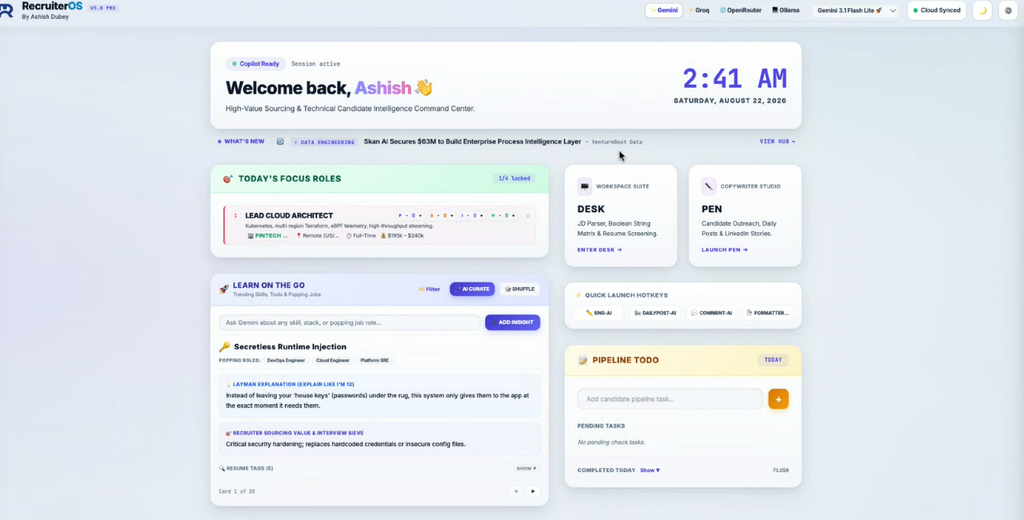
The Use Case That Got Me
Here’s the workflow I kept picturing while Ashish walked me through it, mapped against what I used to do manually.
Understanding the req. In staffing, the job descriptions that land in your queue are rarely clean. They’re often verbose, reused with a laundry list of requirements, accompanied by an Account Manager’s chicken-scratch notes on what actually matters. In RecruiterOS, a recruiter drops the JD into the “Desk” module and gets back a plain-English breakdown of the role, the rationale for why it’s open, and the top skills that actually matter and how to pitch the position to candidates. The same “explain it to me like I’m new” conversation I used to have verbally every day with recruiters, now generated in seconds.
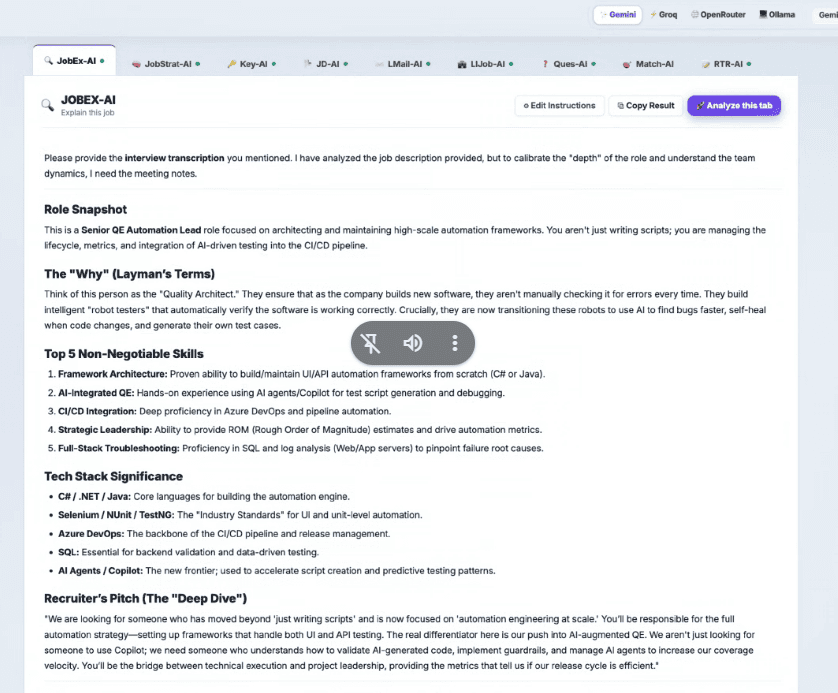
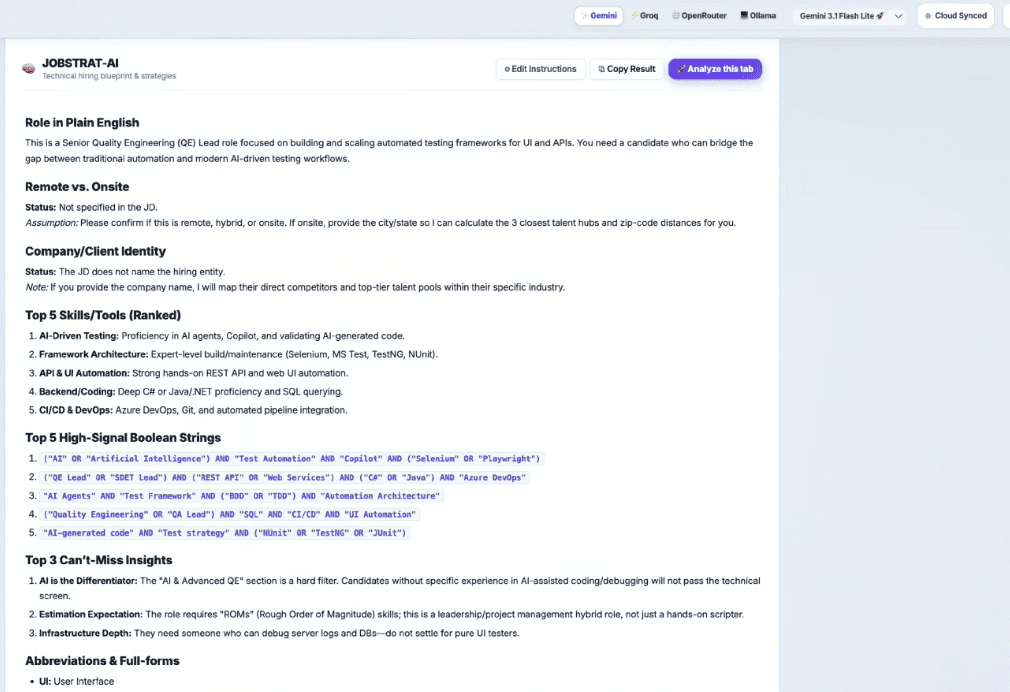
Sourcing strategy. Instead of me sitting next to a recruiter building boolean strings together, the tool generates search strings specifically aligned to whatever platform they’re sourcing on: LinkedIn, Indeed etc.
Writing the outbound. It produces a cleaned-up, candidate-ready job description recruiters can actually push out: solving that verbose-JD problem plus LinkedIn InMail templates and full generated LinkedIn posts to get the req out to market market, all without reading like obvious AI output.
Sounding credible on the call. This is the part that used to require paired calling. The tool researches the underlying tech stack and generates interview questions that go beyond the starter “do you have API experience”: more elevated questions along with the kinds of responses to expect, so a recruiter can hold a conversation instead of just reading a checklist. It also builds an “alignment pitch” to explain the technical role in layman’s terms, plus a cheat sheet with project context for the call itself.
Everything after the call. Resume formatting to match client requirements, sell packages built off client criteria, and Right-to-Represent (R2R) details specific to the req: the administrative back half of the job that eats just as much time as sourcing does.
Why This Matters More Than the Tech Stack
I could write a whole post just on the architecture and it’s worth mentioning briefly, because Ashish built this himself with a genuinely thoughtful approach. But the tech stack isn’t the story. The story is what happens to a training model built almost entirely on senior recruiters’ time.
What used to take me an hour or more per req, per recruiter, could now take 10 to 15 minutes: sit down, walk through what the tool generated together, answer questions, and send them off to work the req on their own. I’m not out of the loop entirely: spot-checking and being available for questions that matter but I’m not the bottleneck anymore. A junior recruiter with three reqs in a day doesn’t need three separate hour-long sit-downs to get up to speed.
And that’s clutch for staffing orgs, especially ones running junior teams or working through an MSP: it’s not that AI replaces the mentor. It’s that it front-loads the parts of mentorship that were always the most repeatable: the JD breakdown, the boolean logic, the tech stack primer etc so the mentor’s actual time gets spent on judgment calls instead of translation.
Thanks to Ashish Dubey for walking me through RecruiterOS and letting me dig into how he built it!