
Job-Intel has helped 100+ job seekers land interviews. The counter stopped. The mission didn’t💞

I was able to pivot my career and land an AI-driven testing role through this community. Great experience all around.
Ryan Rossbach, Automation Engineer @ LoopQA
Straight From the Source
A firsthand read on Charlotte QA hiring – from open roles and recruiter activity to interview trends, team expectations, and what candidates are hearing.

Staffing Contacts
Below is a curated list of local recruiters I either know personally and recommend, or who are active in my network and have been identified through candidate outreach related to IT/QA roles. All names are linked …
-
Credit Karma’s QA Bench Is Strong
Phone’s ringing from folks over @ Credit Karma after the Intuit layoffs. Hearing a decent number of senior QA engineers were impacted.
If you’re hiring and looking for strong quality engineering talent, I’d take a look at the CK roster. There are some really sharp people there.
And if you’re local to Charlotte and were affected, DM me. Happy to help however I can.
Reuters article HERE
-
QA Market Watch: Current Signals
I’ve heard great things about The Hartford from my engineering community over the years. I noticed a couple good lookin’ QA gigs open on their site here locally (R2623925-166 && R2624556-166).
I spoke with a few engineers there today who mentioned they’d spot check what’s currently open. From what I gathered, QA seems to be embedded across most development teams.
One person did mention the first role (Senior Staff Engineer) is fairly niche: looking for someone with 10+ years as an application developer alongside deep QA automation experience. Beyond that, broader hiring priorities and business initiatives are still a little unclear to me.
Nice set of openings though and thought it was worth mentioning. If you’re currently interviewing with The Hartford, feel free to DM me: would love to connect and compare notes.
Plan to update if I can get clarity.
Update 5/13: reqs only show open in the system. Reached out to TA’s to check true status.
Update: 6/3- Spoke with a candidate interviewing with the hiring manager tomorrow 6/4. Looks like Michael is one of the internal TA’s over the req. Can’t wait to see how their tech IV process looks like.Suggested IV prep for The Hartford from current engineer:
Strong understanding of modern test automation frameworks, particularly Playwright, with experience supporting both in-sprint and regression automation initiatives. Practical experience leveraging AI-assisted development tools such as GitHub Copilot and MCP-based workflows to accelerate test creation and improve delivery efficiency. Focused on achieving high automation coverage and quality metrics while balancing speed, maintainability, and business objectives. Experienced with defect lifecycle management, test execution tracking, and Agile delivery environments. Familiar with emerging considerations around AI adoption, including governance, tool usage optimization, and cost/token management.Also curious: if you’ve been getting calls from SMBC in the Charlotte engineering market, I’d be happy to compare notes. Trying to get a better read on the overall landscape and what they’re building locally. Hear great things.
*I do not manage this requirement and simply sharing what I see in the market*
-
Eng Leaders: Scaling QA for AI Systems
One of the more interesting conversations I sat in on recently wasn’t about building AI workflows. It was about maintaining them.
Ovidius AI was discussing a challenge I think a lot of AI implementation firms run into:
How do you maintain delivery quality as AI systems become more complex?
The workflows themselves weren’t the issue. The team already builds across tools like N8N, Next.js, Supabase, and multiple LLMs.
The challenge was operational:
regression testing,
edge cases,
inconsistent AI outputs,
error categorization,
and building QA processes that don’t cost as much as the projects themselves.That led to an interesting discussion with Ben Fellows and the team @ LoopQA around what QA for AI systems actually looks like in practice.
Not just “does this app work,” but:
- how to design reusable test harnesses
- where AI-generated test cases fit
- how to think about deterministic vs. generative outputs
- and how teams build trust and operational visibility around AI-driven workflows
It feels like a lot of companies are entering a new phase of AI adoption. The challenge is no longer just building workflows. It’s figuring out how to scale, validate, and trust them in production.
-
Charlotte QA: Market Watch
Seeing continued demand for senior-level Quality Engineers with automation experience, particularly around modern QA practices, automation coverage, and supporting evolving engineering workflows which is exciting to see.
Example: Hearing TQL recently interviewed for this role and believe this is more of a backfill for an existing team than a broader hiring push. Big but exciting shoes to fill. The role still appears to be open on their website. Definately worth checking out. Click HERE
Charlotte, NC
Salary Listed: $85,000 – $110,000 base salary, benefits package, and company perks**I do not manage or oversee this position**
-
Current Expectations for QA Leaders
A lot of engineering leaders are being asked to solve multiple problems at once:
→ increase delivery speed
→ adopt AI
→ reduce waste
→ and upskill existing teams while still shippingThat last part is…really tough.
I’ve been in the IT TA game for years, staffing up engineering teams and workshops like the ones Ben is leading at LoopQA are interesting because they’re less about “here’s another tool” and more about helping leaders navigate the operational side of modern QA: figuring out what’s actually useful, managing change across teams, and still being accountable for delivery.
Check it out HERE -
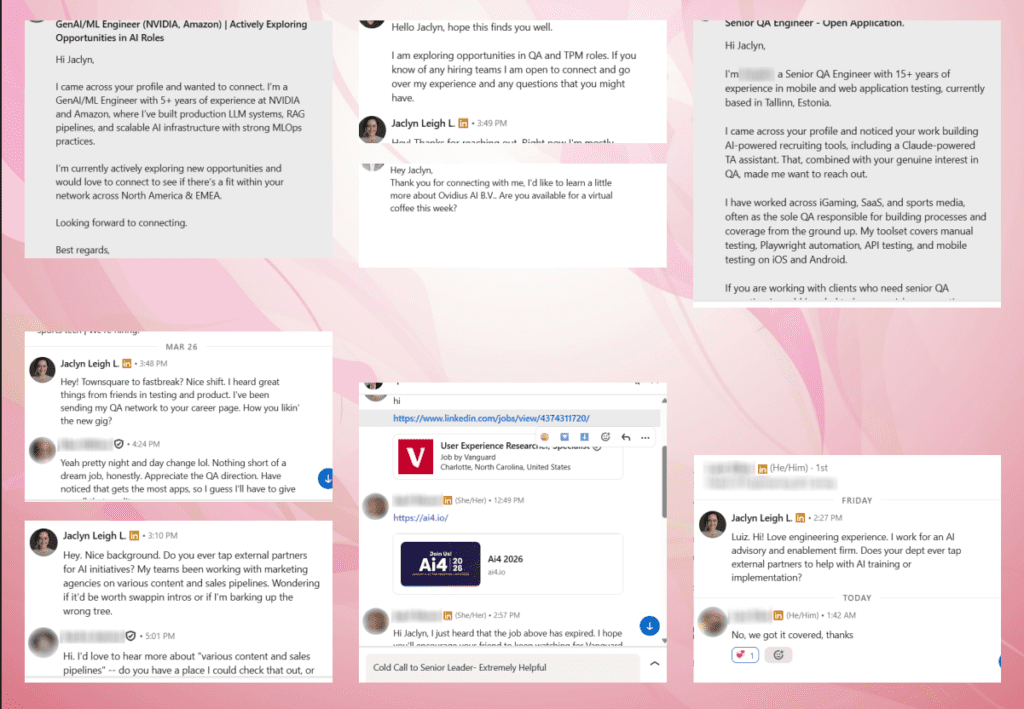
Most outreach fails before it’s even read
If you’re applying to jobs without also reaching out to recruiters or hiring managers in your space, you’re leaving opportunities on the table. But knowing how and when to engage is what actually matters.
Top: what my LinkedIn inbox looks like
~8–10 messages/day.
Owen (my boss) gets about double.Nothing wrong with the messages.
But when everything sounds the same, it all blends together.Especially when you’re skimming between meetings…
you don’t get much time to “figure out” what someone means.
Bottom: how I try to approach outreach
I don’t always get a response.
Some of it works, some of it doesn’t.But the goal is simple:
if someone reads it once, they should immediately know:- what I’m asking for
- why it matters to them
No decoding required.
Most outreach fails because it optimizes for sounding professional instead of being understood.
Make it easy on the other person to respond.Genuine question:
Do you think “professional language” actually helps outreach…or has it just become noise we’ve all learned to skim past?Sample Messages:
What People Are Saying
In an employer-driven market, it’s rare to find a resource that combines hiring insight with real candidate experiences. Highly recommend InsitePeek as a valuable source of market intelligence.
Jonathan Hofler
Senior AI Augmented QA Engineer

InsitePeek provides credible, high-signal insight into the Charlotte job market; valuable information for the community
Chris Bettini
Head of Portfolio Analytics Product Management

I’ve mentored Jaclyn for years and have watched her grow into a true recruiting SME. She’s built a strong resource for the Charlotte engineering community, especially around quality engineering, hiring, and industry insights.
John Dye
Hands-On Platform Engineering Leader

This is a fantastic site for staying up to date on the Quality Engineering market, from hiring trends to evolving skill demands. It keeps you grounded in what teams are actually prioritizing so you can stay ahead of where the industry is headed.
Deepak Nagabhushanam
Technical Director, R&D Portfolio Lead

I’ve worked with Jaclyn for years. Exceptional recruiter with a great understanding of the market. InsitePeek is a valuable source of insight covering everything from hiring activity to real candidate experiences, and helping professionals better navigate and control the interview process.
Austin Meadows
Lead Software Engineer

InsitePeek has helped me land conversations and interviews, while also providing insight into testing trends and helping me prepare more effectively for the interview process.
Krista Strzeszkowski
Senior QA

I work closely with engineering teams in Charlotte on hiring and running hands-on AI-driven workshops to help standardize and optimize QA practices. It’s great to see a platform surfacing real hiring and talent movement in motion.
Ben Fellows
Founder & CEO of LoopQA, AI-Driven QA and Automation Leader

A unique resource for the Charlotte tech and business community filled with smart insights and the kind of information you don’t find anywhere else.
Will Rauddi
Engineering Leader

What a great hub for real market insight and genuine community connection…I find myself coming back for the blogs.
Steven Boucher
Senior Automation Engineer

Jaclyn’s been in the Charlotte tech scene for a long time. Always appreciate how she shares what she’s seeing and helps keep the community informed in a market like this.
Natalie Brennan
Senior QA Engineer, Automation & AI Initiatives